
Cambridge & South Cambridgeshire
Small Frontages, Tight Access and Conservation Areas: Imprinted Concrete in Cambridge
A city of narrow Victorian frontages, 1930s semis and a great many gardens that are smaller than the parking space someone wants to put in them.
Family run since 1990
Over 30 years installing decorative surfacing
Based in Sawtry
Local team, Cambridgeshire properties
Five star rated
Verified Google reviews
Imprinted Concrete in Cambridge
Access decides more of these jobs than the ground does
Cambridge is the hardest place in our area to lay a driveway, and it is worth being honest about why. Large parts of the city, the terraces off Mill Road, Romsey, Petersfield and the streets around Chesterton, were built with no off street parking at all, on plots with a few square metres of front garden between the bay window and the pavement. Where a frontage is converted for parking, it is small, it is highly visible from the street, and it is often within a conservation area where what you put down is not entirely your own decision.
The other Cambridge is easier. The interwar and postwar suburbs, Cherry Hinton, Arbury, Kings Hedges, Trumpington and the outer edges, have the ordinary semi detached frontage with a drive, a garage and a lawn, and behave much like anywhere else in the county. Rear gardens across the whole city are where most of our Cambridge work would sit anyway: enclosed, overlooked, seen from the house all year, and a good use for a stamped finish because the pattern is read from close up.
The ground under the city is mixed, with gault clay across much of it and river gravels along the Cam. But in Cambridge the ground is rarely the deciding factor; access is. Terraced streets with residents parking, no rear access and nowhere to stand a vehicle change how a job can be run more than any soil condition does, and that is something to establish before anything else.
Driveways, patios and paths are the three things we install. Read what each one involves or why people choose imprinted concrete.
Make It Your Own
Colours and patterns for Cambridge properties
Cambridge brick runs from soft yellow gault through to Victorian red, often with slate roofs, so the colour choice divides along the same line. Sandstone and the warmer tones sit with gault brick; charcoal and slate grey work with red brick and slate roofs, and suit the more modern suburbs. In a conservation area, colour is worth checking before it is chosen rather than after.
- SandstoneNatural stone tone
- Brick RedClassic heritage
- Slate GreyModern charcoal
- Autumn BrownRich amber
See the full colour and pattern section for photographs of the finishes, or ask us to bring samples when we visit.
Before Anything Is Poured
Ground, access and drainage in Cambridge
Access first, everything else second. We need to know how material gets to the work, whether there is anywhere to stand a vehicle, and whether the street has parking restrictions that affect the day. After that it is the usual questions: levels, where the water goes, and what is under the existing surface. Because imprinted concrete is not permeable, the drainage design on a small city frontage matters a great deal, and it interacts with the planning rules on front gardens.
Recent Projects
Finished work worth comparing against your Cambridge property
For a small enclosed city garden, the close detail of the charcoal cobble setts finish in our projects section shows what the texture actually looks like at the range you would see it from a back door. For a suburban frontage, the charcoal ashlar driveway with a red border is the closer reference.
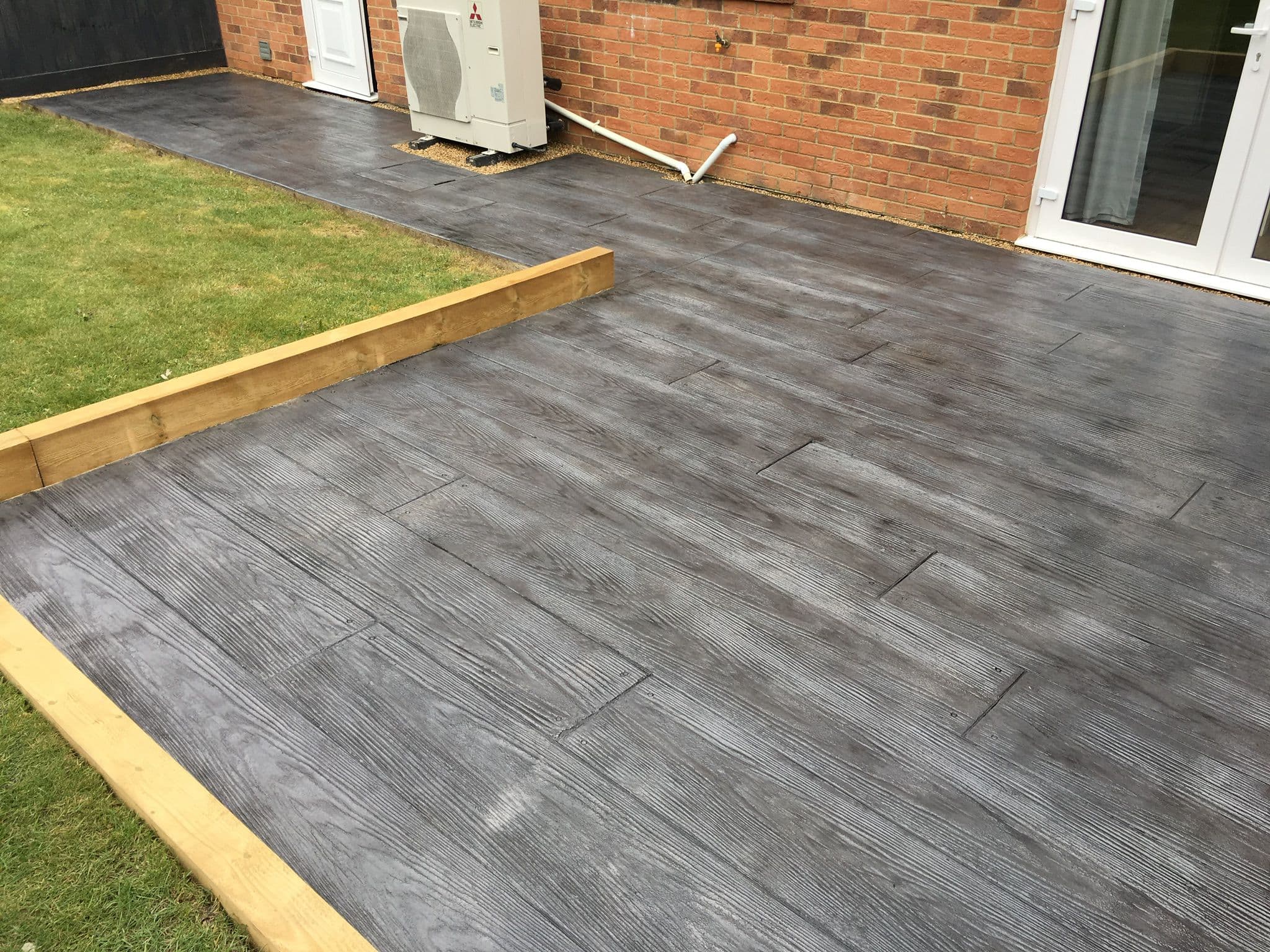
A patio in grey wood plank imprinted concrete: the look of decking boards in a single poured, jointless surface. 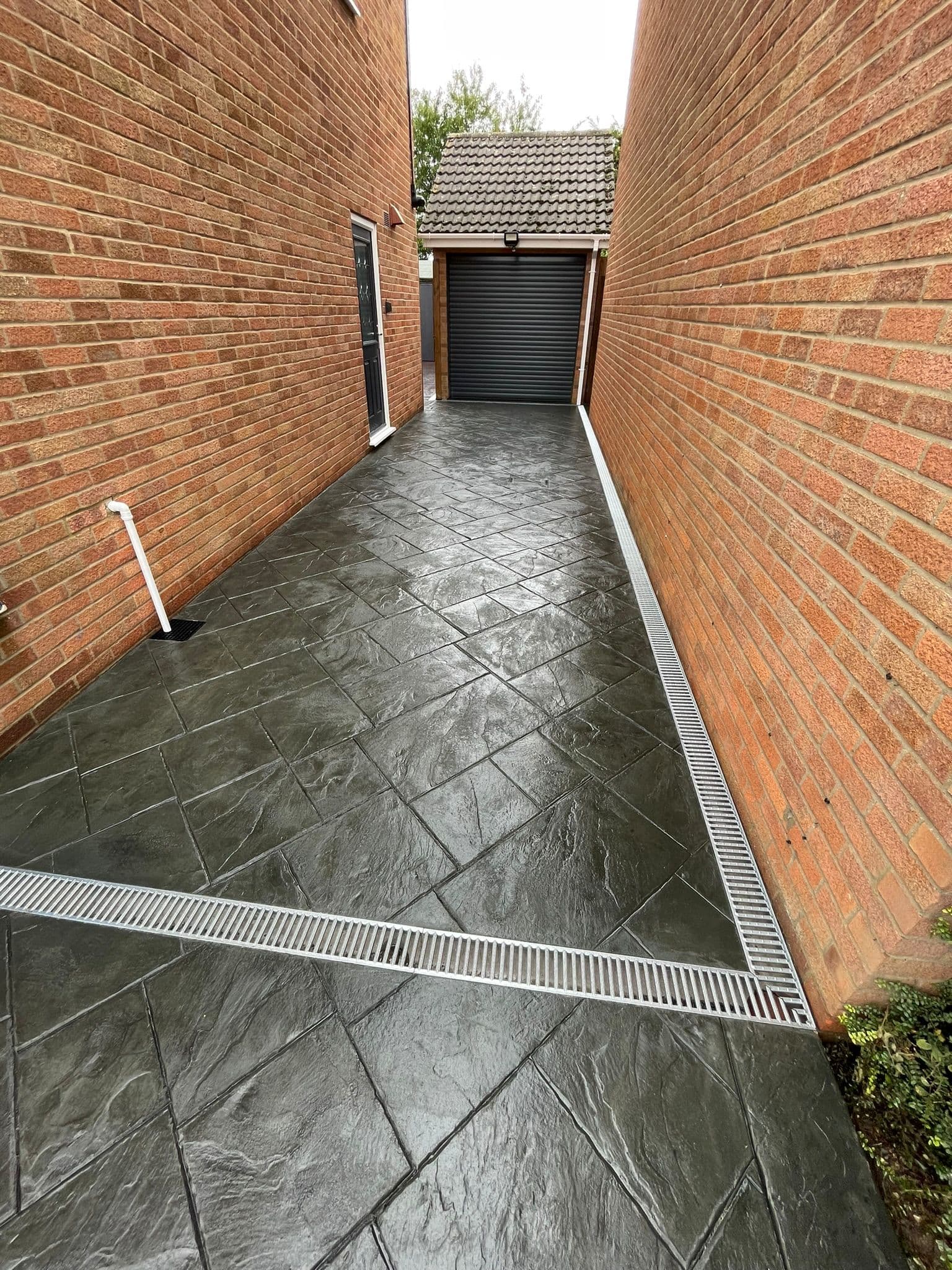
A narrow side access path in charcoal riven stone imprinted concrete, with galvanised channel drains along the run. 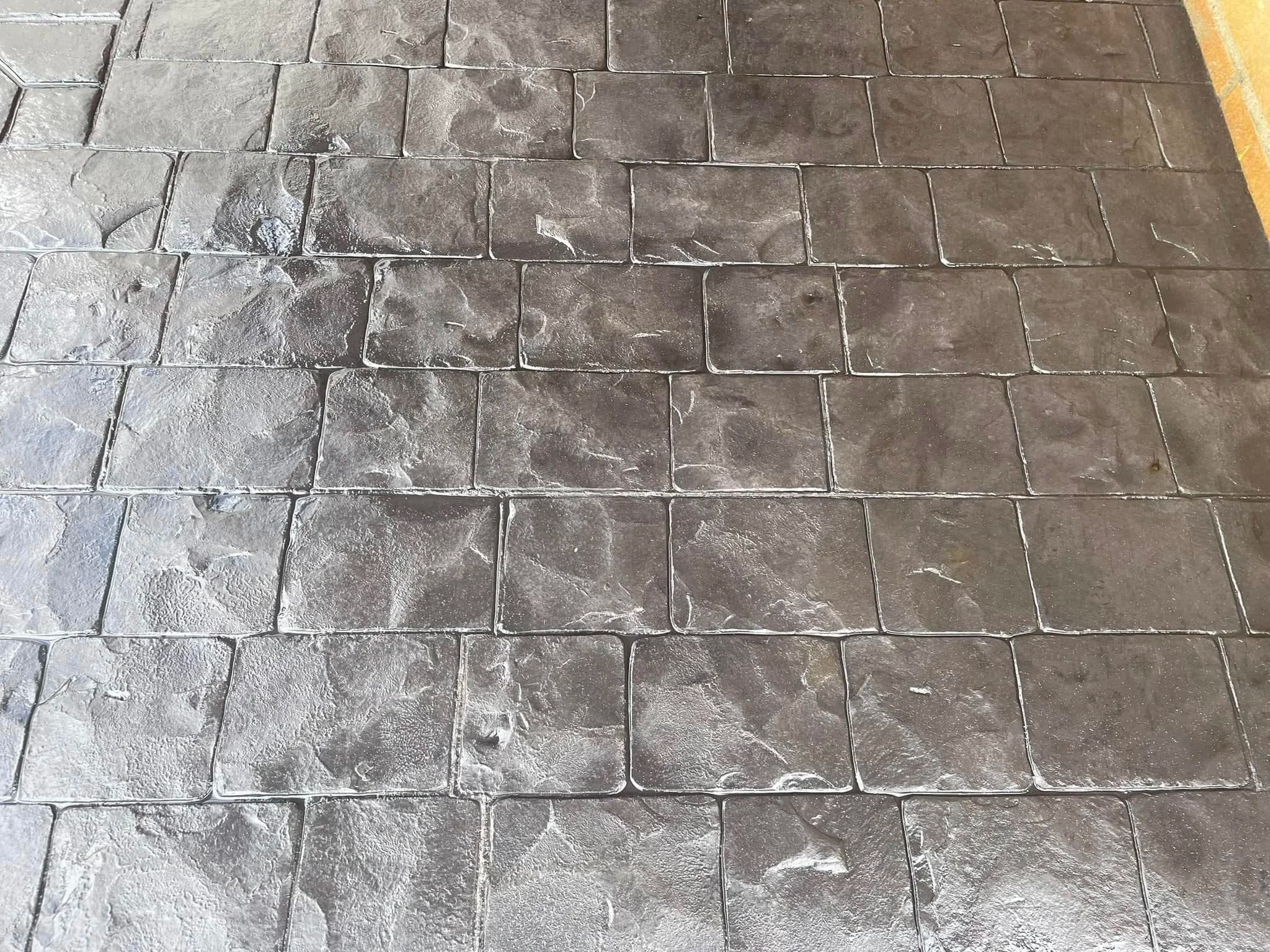
Close detail of a cobble setts finish, showing the riven texture and the pale antiquing highlight that gives the surface its depth.
Five-Star Rated
What customers say
EXCELLENT Based on 12 reviews on Google. These are the company's own Google reviews and are not attributed to any particular town.
Rated 5 out of 5.
They did a brilliant job on our garden, good value and a great finish. Highly recommend :)
Questions
Cambridge imprinted concrete questions
- Do you take on work in Cambridge itself?
- Cambridge is named in the service area Driveway & Decking Co. publish. Whether a specific Cambridge job is practical depends heavily on access and on the size of the area, so send the postcode and a description through the quote form and we will give you a straight answer rather than a maybe.
- Do I need planning permission to pave my front garden in Cambridge?
- Quite possibly. In England, laying more than five square metres of a front garden with a surface that does not let water through needs planning permission unless the run off goes to a permeable area inside your own boundary. Cambridge also has extensive conservation areas and many properties with additional restrictions, so Cambridge City Council is the authority to check with before you commit to anything.
- My street is a terrace with residents parking. Can you still work there?
- It depends on the street and the day. Somewhere to stand a vehicle and a route to get material to the work are the two things that decide it. Tell us about the access when you enquire and we will be honest about whether it is workable rather than turning up and finding out.
- Is a very small front garden worth doing in imprinted concrete?
- Sometimes, and sometimes not. A very small area does not give a pattern room to repeat, and the practical costs of getting to a city centre site do not scale down with the area. We would rather tell you that a small city frontage is a poor fit than take the job and leave you disappointed.
- What about back gardens and courtyards?
- Enclosed gardens are one of the better uses for a stamped finish, because you see the texture from close up and from the house every day. The constraint in Cambridge is nearly always getting to the garden: if there is no rear access and everything has to come through the house, that changes what is realistic.
- Which pattern suits a Victorian terrace?
- Small scale finishes. London cobble, herringbone brick and the finer riven stone patterns keep the same rhythm as Victorian brickwork and setts. Large slab patterns are the wrong scale for a short frontage and tend to look like a modern surface dropped in front of an old house.
- Can you match the colour of the college stone or old brick?
- We can choose something sympathetic, and we bring samples so you can hold them against the actual wall. We would not claim to match a specific historic stone or brick exactly, because a coloured concrete surface is a different material with a different surface and it will not behave identically as it weathers.
- Do you work for landlords and rental properties?
- Yes, provided the person instructing us has the authority to have the work done. For a leasehold or shared property it is worth confirming who needs to agree before we quote.
- How does an imprinted surface deal with a shared alley or passage?
- Passages between terraces are usually shared, which makes the rights of access and the responsibility for the surface the first question rather than the last. Once that is clear, a narrow run is technically straightforward and is often better in a continuous surface than in units, because there are no repeated joints down its length.
- What is the biggest practical constraint in Cambridge?
- Access, by a distance. Ground conditions in the city are workable and the design questions are the same as anywhere. It is getting plant, material and a team to a small site on a busy street that decides whether a job is sensible.
- Can you advise before I apply for permission?
- We can tell you what we would propose and how the surface water would be dealt with, which is usually the part a permission question turns on. The decision itself is the council's, and we would not tell you what they will say.
- How do I get a Cambridge enquiry looked at?
- Use the quote form on this page with your postcode, the approximate size and a note about access, call or WhatsApp 07949 078999. The access detail genuinely matters here, so include it.
Areas We Cover
Near Cambridge
Each of these has its own page, written for that place rather than this one.
Get a Free Quote
Request a quote for your Cambridge project
Tell the team whether you are planning a driveway, patio, path or another suitable imprinted concrete project. Include the postcode and an approximate size or a short description, and Driveway & Decking Co. can talk through the next step and arrange a quote or a site visit where that makes sense.
Prefer to talk it through?
- Telephone
- 07949 078999
- Message us on WhatsApp
- Address
- 23 Glatton Road, Sawtry, Huntingdon, Cambridgeshire PE28 5SY